

Case Study · Liquid Applied Flat Roofing
Building 900, Chesterford Research Park
A full flat roof refurbishment across five distinct roof areas —
combining strip-and-replace, substrate overlay, and a fully reinforced
liquid waterproofing system that keeps an occupied space watertight
throughout the works.
Restoring Watertightness Across Five Roof Areas
Cambridge Roofers were appointed to carry out a full refurbishment of the
flat roof areas at Building 900, Chesterford Research Park, Saffron Walden.
The building’s flat roofs had reached the end of their serviceable life,
and the client required a long-term waterproofing solution that would
restore watertightness, improve thermal performance and provide a robust,
warranted finish across a range of roof types and substrates.
No single approach fit every roof on site — the brief called for
a tailored build-up on each area, from full strip-out to substrate
overlay, all tied together under one warranted system.
Five Roofs, Five Sets of Constraints
The project covered several distinct roof areas, each with its own
substrate, access, and performance requirements.
Full Strip-Out
Existing waterproofing needed to be fully stripped back to the
structural deck before a new insulated system could be installed.
Masonry Substrate
Sitting on a masonry substrate, the existing build-up needed to be
overlaid rather than fully replaced.
Occupied Canopy
Occupied space beneath the canopy roof meant watertightness had to
be maintained throughout, with temporary weathering during works.
Thermal Performance
Achieving good thermal performance without compromising drainage
falls or the available upstand heights was a key consideration.
Detailing at Junctions
Parapets, thresholds and abutments all needed careful detailing to
protect the integrity of the finished system.
Warranted Finish
The client required a robust, fully warranted finish consistent
across every roof type and substrate on site.
Method & Sequence
Work began with careful strip-out where a full replacement was needed,
and a prepared overlay where the substrate allowed it — with the
same standard of detailing applied across every roof area.
Strip-Out to Structural Deck
Roofs 1, 2, 3 and 5 were stripped back, removing redundant materials
and trims to a clean structural substrate ready for the new build-up.
Masonry Overlay Preparation
On Roof 4, the existing masonry substrate was prepared to receive an
overlay system, in line with Triflex’s requirements for that substrate.
Tapered Insulation & Membrane
A tapered insulation scheme was installed across the main roof areas
to target a design U-value of 0.18 W/m²K while maintaining correct
falls and drainage, before the Triflex ProTect reinforced liquid
membrane was applied as a fully bonded, insulated warm roof system.
Perimeter & Penetration Detailing
All perimeters, upstands, outlets and penetrations were detailed using
the Triflex ProDetail system, with primers and reinforcement used
throughout for a seamless, fully bonded finish at every junction.
Tailored Build-Up, Per Roof
Triflex Reinforced Liquid System
On Roof 4, the Triflex ProFloor RS wearing layer was applied as an
overlay system, with the same attention given to perimeter and outlet
detailing. On Roof 5, particular care was taken to protect the occupied
space below and maintain watertightness at every stage, with a
Triflex-compatible wearing finish applied to areas of the canopy
subject to foot traffic.
From Stripped Deck to Finished System
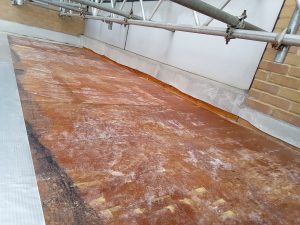
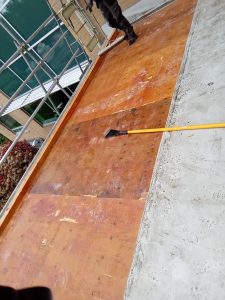
Strip-Out & Substrate Preparation
The existing roof coverings were stripped back to expose the structural
plywood deck, removing all redundant layers and trims to leave a clean,
sound base for the new system.
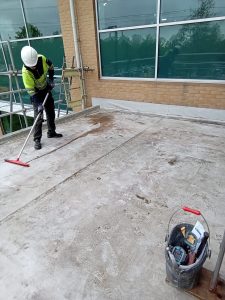
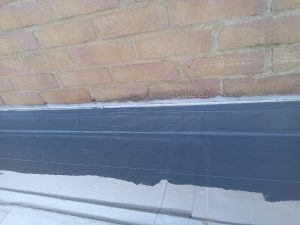
Detailing & Membrane Application
Perimeter upstands and abutments were built up and detailed using the
Triflex ProDetail system to ensure a fully bonded, watertight junction
at every wall and threshold.
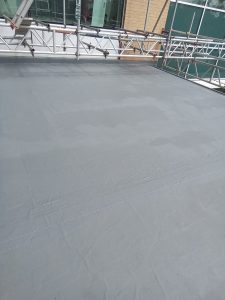
Completed Roof
The finished roof provides a fully reinforced, seamless liquid
waterproofing system across the main roof area, tied into the
surrounding upstands and details.
One Warranted System, Tailored to Five Roofs
The refurbishment at Building 900, Chesterford Research Park was
completed to a high standard across all five roof areas, each tailored
to its specific substrate and site constraints. By combining full strip
and replacement where needed with a targeted overlay approach on the
masonry roof, and by maintaining strict watertightness on the occupied
canopy roof throughout, Cambridge Roofers delivered a durable, thermally
improved and fully warranted liquid applied roofing system for the client.
Substrate-Led Build-Ups
Strip-and-replace and overlay methods were applied where each was right.
Improved Thermal Performance
Tapered insulation targeted a 0.18 W/m²K U-value without losing falls.
Watertight Throughout
The occupied canopy roof stayed weathered and safe at every stage.
Talk to Us About Liquid Applied Flat Roofing
Whether it’s a single flat roof or a multi-substrate refurbishment across
a wider site, our Triflex-approved team can design and deliver a
warranted system that fits every roof area.